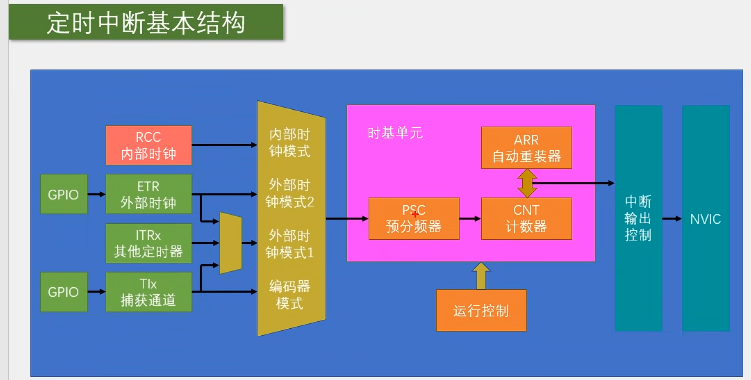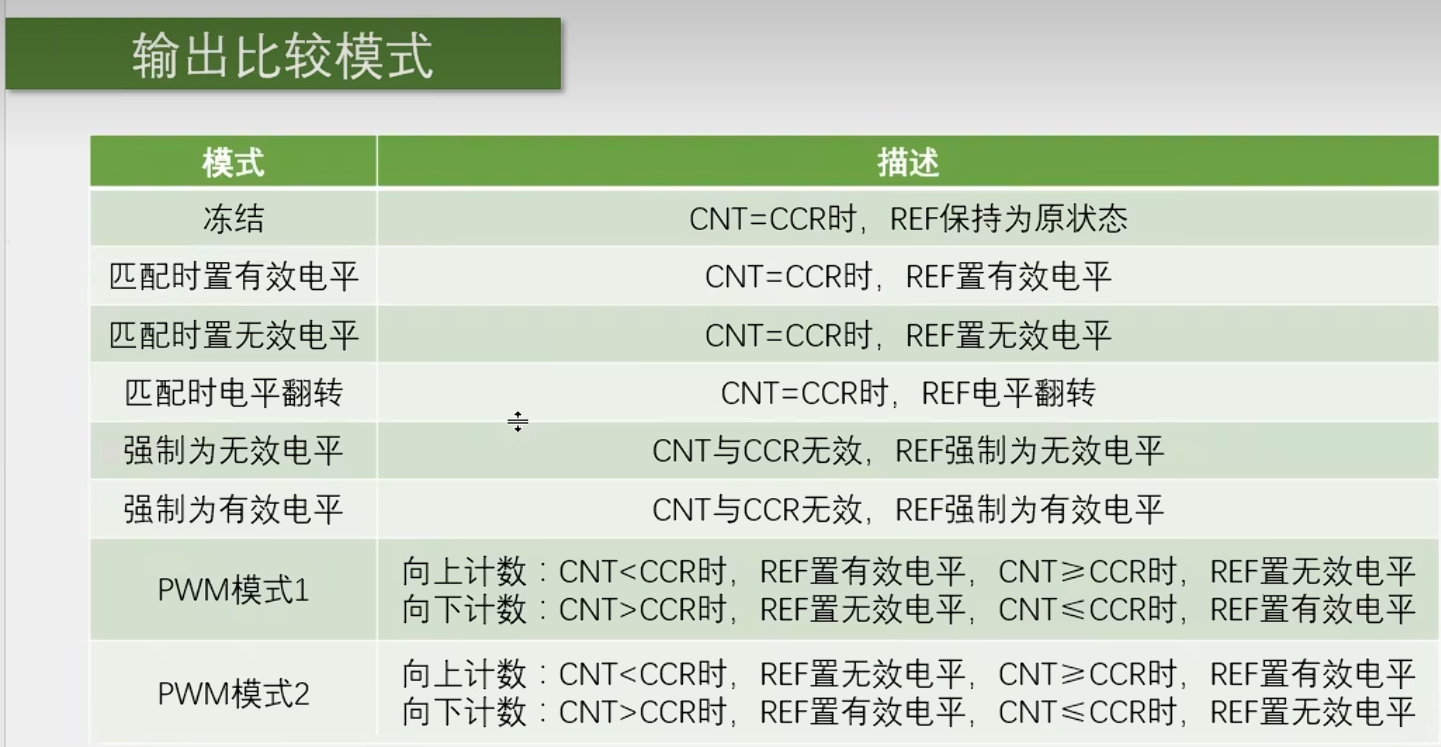
准备工作

STM32是ST公司基于ARMCortex-M内核开发的32位微控制器

stm32F1的所有外设
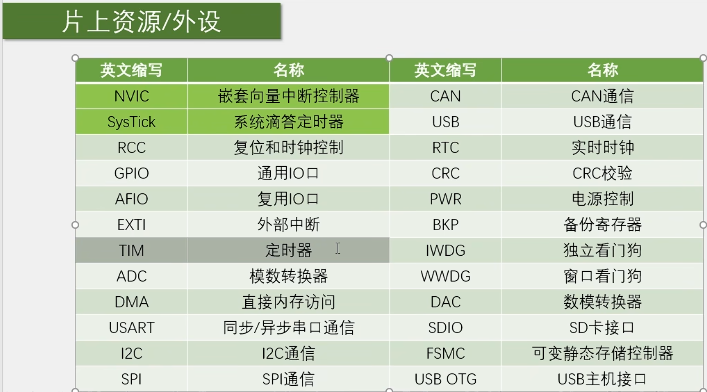
外设表

约定成俗的杜邦线:黑色接地(gnd),红色接vcc,黄或橙接时钟,蓝色或绿色接数据线,白色或灰色或紫色接控制线或其他线

GPIO输出
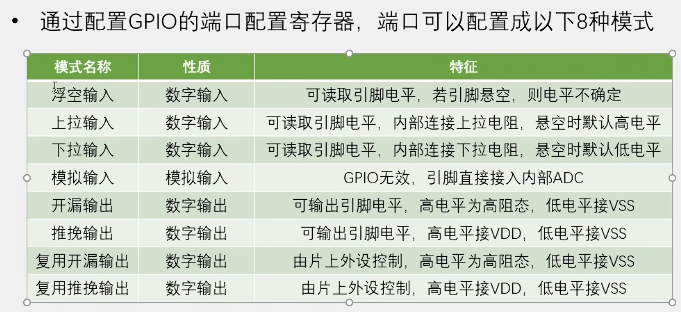
8种模式

GPIO介绍

在STM32中I/O引脚,又称GPIO,可以被软件设置成各种不同的功能及模式。

分为输入(4 种)和输出 / 复用(4 种)两大类,核心区别是引脚是否主动输出电平、是否由外设复用;

GPIO相关寄存器配置

调用库函数来配置寄存器,可以脱离底层寄存器操作,使得开发效率提高,同时易于阅读和维护。GPIO相关的函数和定义分布在固件库文件stm32f10x_gpio.c和头文件stm32f10x_gpio.h中。

GPIO——IniTypeDef结构体的定义:

1
2
3
4
5
6
7
typedef struct
{
unit16_t GPIO_Pin; //GPIO引脚
GPIOMode_TypeDef GPIO_Mode; //GPIO模式
GPIOSpeed_TypeDef GPIO_speed; //GPIO速度
}

八个模式

1
2
3
4
5
6
7
8
9
10
11
typedef enum
{ GPIO_Mode_AIN = 0x0,//模拟输入模式
GPIO_Mode_IN_FLOATING = 0x04,//浮空输入模式
GPIO_Mode_IPD = 0x28,//下拉输入模式
GPIO_Mode_IPU = 0x48,//上拉输入模式
GPIO_Mode_Out_OD = 0x14,//开漏输出模式
GPIO_Mode_Out_PP = 0x10,//推挽输出模式
GPIO_Mode_AF_OD = 0x1C,//复用功能开漏输出
GPIO_Mode_AF_PP = 0x18//复用功能推挽输出
}GPIOMode_TypeDef;

OLED

串口调试:通过串口通信,将调试信息发送到电脑端,电脑使用串口助手显示调试信息

显示屏调试:直接将显示屏连接到单片机,将调试信息打印在显示屏上

Keli调试模式:借助Keli软件的调试模式,可使用单步运行,设置断点,查看寄存器及变量等功能
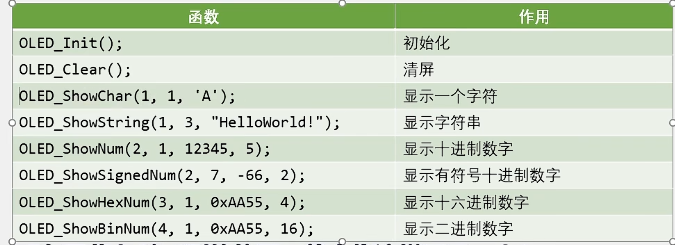
OLED驱动函数

代码保存

点亮第一个led灯

1
2
3
4
5
6
7
8
9
10
11
12
13
14
15
16
17
18
#include "stm32f10x.h"                  // Device header

int main(void)
{
while(1)
{
RCC_APB2PeriphClockCmd(RCC_APB2Periph_GPIOA,ENABLE);//开启时钟
GPIO_InitTypeDef GPIO_InitStructure;
GPIO_InitStructure.GPIO_Mode=GPIO_Mode_Out_PP;
GPIO_InitStructure.GPIO_Pin=GPIO_Pin_0;
GPIO_InitStructure.GPIO_Speed=GPIO_Speed_50MHz;
GPIO_Init(GPIOA,&GPIO_InitStructure);//完成初始化

GPIO_ResetBits(GPIOA,GPIO_Pin_0);
}

}

led灯闪烁

1
2
3
4
5
6
7
8
9
10
11
12
13
14
15
16
17
18
19
20
21
22
23
24
#include "stm32f10x.h"                  // Device header
#include "Delay.h"

int main(void)
{

RCC_APB2PeriphClockCmd(RCC_APB2Periph_GPIOA,ENABLE);//开启时钟
GPIO_InitTypeDef GPIO_InitStructure;
GPIO_InitStructure.GPIO_Mode=GPIO_Mode_Out_PP;
GPIO_InitStructure.GPIO_Pin=GPIO_Pin_0;
GPIO_InitStructure.GPIO_Speed=GPIO_Speed_50MHz;
GPIO_Init(GPIOA,&GPIO_InitStructure);//完成初始化

GPIO_WriteBit(GPIOA,GPIO_Pin_0,Bit_RESET);

while(1)
{
GPIO_WriteBit(GPIOA,GPIO_Pin_0,Bit_RESET);
Delay_ms(500);
GPIO_WriteBit(GPIOA,GPIO_Pin_0,Bit_SET);
Delay_ms(500);
}
}

led流水灯

1
2
3
4
5
6
7
8
9
10
11
12
13
14
15
16
17
18
19
20
21
22
23
24
25
26
27
28
29
30
31
32
33
34
35
#include "stm32f10x.h"                  // Device header
#include "Delay.h"

int main(void)
{

RCC_APB2PeriphClockCmd(RCC_APB2Periph_GPIOA,ENABLE);//开启时钟
GPIO_InitTypeDef GPIO_InitStructure;
GPIO_InitStructure.GPIO_Mode=GPIO_Mode_Out_OD;
GPIO_InitStructure.GPIO_Pin=GPIO_Pin_All;
GPIO_InitStructure.GPIO_Speed=GPIO_Speed_50MHz;
GPIO_Init(GPIOA,&GPIO_InitStructure);//完成初始化

GPIO_WriteBit(GPIOA,GPIO_Pin_0,Bit_RESET);

while(1)
{
GPIO_Write(GPIOA,~0x0001);//0000 0000 0000 0001;
Delay_ms(500);
GPIO_Write(GPIOA,~0x0002);//0000 0000 0000 0010;
Delay_ms(500);
GPIO_Write(GPIOA,~0x0004);//0000 0000 0000 0100;
Delay_ms(500);
GPIO_Write(GPIOA,~0x0008);//0000 0000 0000 1000;
Delay_ms(500);
GPIO_Write(GPIOA,~0x0010);//0000 0000 0001 0000;
Delay_ms(500);
GPIO_Write(GPIOA,~0x0020);//0000 0000 0010 0000;
Delay_ms(500);
GPIO_Write(GPIOA,~0x0040);//0000 0000 0100 0000;
Delay_ms(500);
GPIO_Write(GPIOA,~0x0080);//0000 0000 1000 0000;
Delay_ms(500);
}
}

蜂鸣器

1
2
3
4
5
6
7
8
9
10
11
12
13
14
15
16
17
18
19
20
21
22
23
24
25
26
27
28
#include "stm32f10x.h"                  // Device header
#include "Delay.h"

int main(void)
{

RCC_APB2PeriphClockCmd(RCC_APB2Periph_GPIOB,ENABLE);//开启时钟
GPIO_InitTypeDef GPIO_InitStructure;
GPIO_InitStructure.GPIO_Mode=GPIO_Mode_Out_PP;
GPIO_InitStructure.GPIO_Pin=GPIO_Pin_12;
GPIO_InitStructure.GPIO_Speed=GPIO_Speed_50MHz;
GPIO_Init(GPIOB,&GPIO_InitStructure);//完成初始化


while(1)
{
GPIO_ResetBits(GPIOB,GPIO_Pin_12);
Delay_ms(500);

GPIO_SetBits(GPIOB,GPIO_Pin_12);
Delay_ms(500);


}

}

按键控制led

1
2
3
4
5
6
7
8
9
10
11
12
13
14
15
16
17
18
19
20
21
22
23
24
25
26
27
28
29
30
31
32
33
34
35
36
37
38
39
40
41
42
43
44
45
46
47
48
49
50
51
52
53
54
55
56
57
58
59
60
61
62
63
64
65
66
67
68
69
70
71
72
73
74
75
76
77
78
79
80
81
82
83
84
85
86
87
88
89
90
91
92
93
94
95
96
97
98
99
100
101
102
#include "stm32f10x.h"                  // Device header
#include "Delay.h"
#include "LED.h"
#include "Key.h"

uint8_t KeyNum;

int main(void)
{
LED_Init();
Key_Init();
while(1)
{
KeyNum=Key_GetNum();
if(KeyNum==1)
{
LED1_ON();
}
if(KeyNum==2)
{
LED1_OFF();
}
}


}

#include "stm32f10x.h" // Device header
#include "Delay.h"
void Key_Init(void)
{
RCC_APB2PeriphClockCmd(RCC_APB2Periph_GPIOB,ENABLE);

GPIO_InitTypeDef GPIO_InitStructure;
GPIO_InitStructure.GPIO_Mode= GPIO_Mode_IPU;
GPIO_InitStructure.GPIO_Pin= GPIO_Pin_1 | GPIO_Pin_11;
GPIO_InitStructure.GPIO_Speed= GPIO_Speed_50MHz;\
GPIO_Init(GPIOB,&GPIO_InitStructure);
}

uint8_t Key_GetNum(void)
{
uint8_t KeyNum=0;
if (GPIO_ReadInputDataBit(GPIOB,GPIO_Pin_1)==0)
{
Delay_ms(20);
while(GPIO_ReadInputDataBit(GPIOB,GPIO_Pin_1)==0);
Delay_ms(20);
KeyNum=1;

}

if (GPIO_ReadInputDataBit(GPIOB,GPIO_Pin_11)==0)
{
Delay_ms(20);
while(GPIO_ReadInputDataBit(GPIOB,GPIO_Pin_1)==0);
Delay_ms(20);
KeyNum=2;

}
return KeyNum;

}


#include "stm32f10x.h" // Device header

void LED_Init(void)
{
RCC_APB2PeriphClockCmd(RCC_APB2Periph_GPIOA,ENABLE);

GPIO_InitTypeDef GPIO_InitStructure;
GPIO_InitStructure.GPIO_Mode= GPIO_Mode_Out_PP;
GPIO_InitStructure.GPIO_Pin= GPIO_Pin_1 | GPIO_Pin_2;
GPIO_InitStructure.GPIO_Speed= GPIO_Speed_50MHz;
GPIO_Init(GPIOA,&GPIO_InitStructure);

GPIO_SetBits(GPIOA,GPIO_Pin_1 | GPIO_Pin_2);
}

void LED1_ON(void)
{
GPIO_ResetBits(GPIOA,GPIO_Pin_1);
}

void LED1_OFF(void)
{
GPIO_SetBits(GPIOA,GPIO_Pin_1);
}

void LED2_ON(void)
{
GPIO_ResetBits(GPIOA,GPIO_Pin_2);
}

void LED2_OFF(void)
{
GPIO_SetBits(GPIOA,GPIO_Pin_2);
}


独立按键控制led

1
2
3
4
5
6
7
8
9
10
11
12
13
14
15
16
17
18
19
20
21
22
23
24
25
26
27
28
29
30
31
32
33
34
35
36
37
38
39
40
41
42
43
44
45
46
47
48
49
50
51
52
53
54
55
56
57
58
59
60
61
62
63
64
65
66
67
68
#include "stm32f10x.h"                  // Device header
#include "Delay.h"
#include "LED.h"
#include "Key.h"

uint8_t KeyNum;

int main(void)
{
LED_Init();
Key_Init();
while(1)
{
KeyNum=Key_GetNum();
if(KeyNum==1)
{
LED1_Turn();
}
if(KeyNum==2)
{
LED2_Turn();
}
}

#include "stm32f10x.h" // Device header
#include "Delay.h"
void Key_Init(void)
{
RCC_APB2PeriphClockCmd(RCC_APB2Periph_GPIOB,ENABLE);

GPIO_InitTypeDef GPIO_InitStructure;
GPIO_InitStructure.GPIO_Mode= GPIO_Mode_IPU;
GPIO_InitStructure.GPIO_Pin= GPIO_Pin_1 | GPIO_Pin_11;
GPIO_InitStructure.GPIO_Speed= GPIO_Speed_50MHz;\
GPIO_Init(GPIOB,&GPIO_InitStructure);
}

uint8_t Key_GetNum(void)
{
uint8_t KeyNum=0;
if (GPIO_ReadInputDataBit(GPIOB,GPIO_Pin_1)==0)
{
Delay_ms(20);
while(GPIO_ReadInputDataBit(GPIOB,GPIO_Pin_1)==0);
Delay_ms(20);
KeyNum=1;

}

if (GPIO_ReadInputDataBit(GPIOB,GPIO_Pin_11)==0)
{
Delay_ms(20);
while(GPIO_ReadInputDataBit(GPIOB,GPIO_Pin_1)==0);
Delay_ms(20);
KeyNum=2;

}
return KeyNum;

}


}


光敏传感器连传感器

1
2
3
4
5
6
7
8
9
10
11
12
13
14
15
16
17
18
19
20
21
22
23
24
25
26
27
28
29
30
31
32
33
34
35
36
37
38
39
40
41
42
43
44
45
46
47
48
#include "stm32f10x.h"                  // Device header
#include "Delay.h"
#include "LED.h"
#include "Key.h"
#include "Buzzer.h"
#include "LightSensor.h"
uint8_t KeyNum;

int main(void)
{
BUZZER_Init();
LightSensor_Init();
while(1)
{
if(LightSensor_Get()==1)
{
BUZZER1_ON();
}
else
{
BUZZER1_OFF();
}
}


}

#include "stm32f10x.h" // Device header

void LightSensor_Init()
{
RCC_APB2PeriphClockCmd(RCC_APB2Periph_GPIOB,ENABLE);

GPIO_InitTypeDef GPIO_InitStructure;
GPIO_InitStructure.GPIO_Mode= GPIO_Mode_IPU;
GPIO_InitStructure.GPIO_Pin= GPIO_Pin_13;
GPIO_InitStructure.GPIO_Speed= GPIO_Speed_50MHz;
GPIO_Init(GPIOB,&GPIO_InitStructure);

GPIO_SetBits(GPIOB,GPIO_Pin_13);
}

uint8_t LightSensor_Get(void)
{
return GPIO_ReadInputDataBit(GPIOB,GPIO_Pin_13);
}